The short version
Long-standing manufacturers sit on enormous backlogs of hand-drawn or flat 2D engineering drawings that were never turned into 3D models. Converting a single product line by hand can take months. AI can compress that dramatically — but only with the right process, because naive AI conversion fails in specific, predictable ways. The technique that works puts engineering feedback before the model is generated, not after.
The backlog nobody has time for
In any manufacturer with a long history, a large share of the engineering catalog predates modern 3D CAD. These are 2D drawings — many originally drawn by hand, later scanned to PDF — that fully specify a part but have no corresponding 3D model. They work well enough that nobody prioritizes modernizing them, until something forces the issue: a system migration, a configuration-modeling effort, a quality process, or simply the need to manufacture a part whose only documentation is a decades-old drawing.
At that point the organization faces an unpleasant arithmetic. Converting a single significant product line from 2D to 3D by hand can take months of skilled engineering time. Multiply that across a full catalog and the effort is effectively never-ending — which is exactly why the backlog persists. It is too big to do manually and too important to ignore.
This is the kind of problem AI is genuinely suited to compress. But "point AI at a drawing and get a model" does not work, and it is worth being honest about why.
Why naive AI conversion fails
Our first iterations struggled to produce usable models, and the reasons are instructive because they generalize to most AI-on-engineering-documents work.
A 2D engineering drawing is denser and more ambiguous than it looks. It mixes the actual geometry of the part with a great deal of other information: dimension lines, leader lines, tolerance callouts, section indicators, notes, title blocks. A human engineer reads all of this fluently and knows instantly which lines are the part and which are annotation. An AI model, left to its own devices, does not reliably make that distinction — it confuses leader lines and dimension markers for features of the part itself, and produces a model that is subtly or badly wrong.
The naive approach — generate the 3D model, then have an engineer check it — turns out to be the wrong order. By the time the model exists, the errors are baked in, and correcting them can take as long as doing it by hand would have. The review-after model does not save the time it promised.
The technique that works: engineering feedback before generation
What we arrived at inverts the sequence. Instead of generating a model and reviewing it, we insert engineering understanding before the model is built.
First, convert the drawing into a structured, reviewable representation. Rather than jumping straight to 3D, AI first interprets the 2D drawing into an intermediate representation — classifying each element as geometry, dimension, annotation, or other — that a person can inspect and correct. This is the step that captures what a human reads effortlessly: which lines are the part, and which are the scaffolding around it.
Let engineering correct that interpretation. Because the intermediate representation is reviewable, an engineer can fix the classification quickly — confirming real geometry, discarding leader lines and annotation — in far less time than it would take to correct a finished but wrong 3D model. The AI has done the tedious first pass; the engineer applies judgment where it matters.
Then generate the 3D model from the corrected interpretation. Only once the drawing has been correctly understood does the system build the model. Working from a clean interpretation, the generated result is dramatically more reliable, because the ambiguity that derailed the naive approach was resolved before generation rather than after.
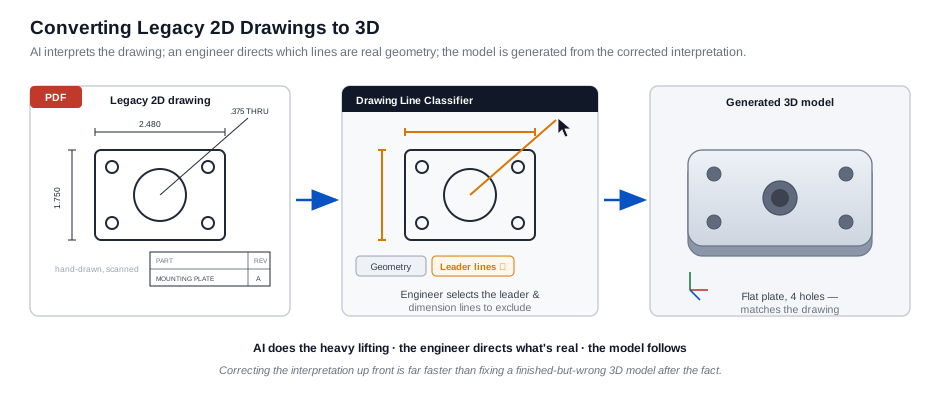
The principle underneath is the same one that governs all of our AI work: AI does the heavy lifting, engineering governs the truth, and the human checkpoint goes at the point of maximum leverage — here, understanding the drawing, not inspecting the output.
Beyond conversion: generating parametric parts
Once the process is reliable, it extends past one-off conversion. Certain classes of parts are highly regular and parametric — springs, fasteners, and similar standardized components — and can be generated from their defining parameters rather than traced from a drawing at all. Generating those directly from specifications, with the same engineering-in-the-loop validation, removes an even larger chunk of the backlog than drawing-by-drawing conversion would.
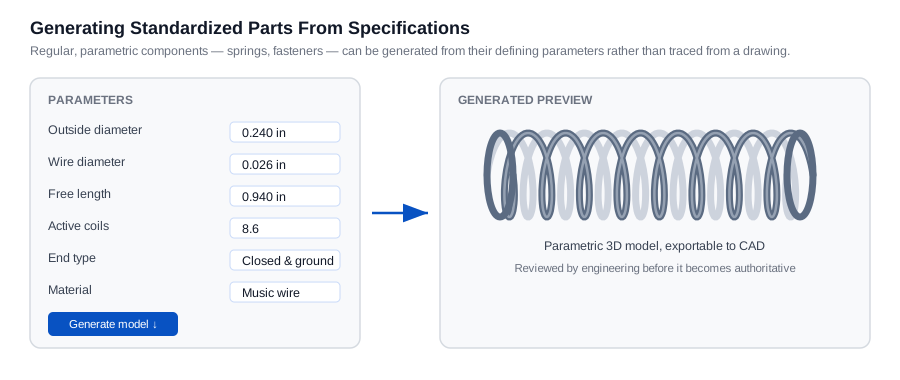
From there the same capability opens further directions worth exploring: converting existing 2D diagrams into 3D models at scale, helping engineers turn 3D scan data (point clouds) into usable models, and auto-generating 2D drawings back out from 3D models to complete the documentation loop.
Why this matters for the broader remediation
This is one workstream inside a larger product-data remediation effort, and it is deliberately sequenced last — because the earlier work of establishing a trusted part foundation and rebuilding configuration rules is what makes the CAD backlog tractable and worth closing. But it is also the most visible proof of what AI-accelerated, engineering-governed remediation can do: taking a task measured in months of manual effort and compressing it, without sacrificing the correctness that engineering work demands.
The lesson generalizes well beyond CAD. When you apply AI to complex engineering documents, the failures come from ambiguity the AI cannot resolve on its own, and the fix is not a better model — it is putting human expertise at the right checkpoint, early, where a small amount of judgment prevents a large amount of downstream error.
This is part of a series on how we approach product-data remediation for complex manufacturers. See the series overview for the full phased program, the piece on reconciling broken product data, and the companion on rebuilding configuration rules.