The short version
Manufacturers in long-standing engineering industries accumulate decades of fragmented product data — hand-drawn diagrams that never became 3D models, part records split across merged ERPs, drawings scattered across multiple CAD and PLM systems. The gaps are not a performance problem; they are structural, and they compound over time. This is how we approach remediating them: a phased, AI-accelerated program that fixes the data foundation first, then builds on it.
The problem is structural, not a failure of effort
Consider a global manufacturer in an industry that has existed for a century. Its products have lifecycles measured in decades. Over that time it has grown through acquisitions, each bringing its own systems. It has transferred production between plants, and every transfer left some tribal knowledge behind. It has run more than one ERP and more than one CAD or PLM system, and the migrations between them were never perfectly clean. The engineering catalog includes drawings that were originally done by hand and never fully modernized.
The result is predictable, and we see it across this entire category of company: product data that is incomplete, fragmented, and inconsistent across systems. Critical attributes — finishes, substrates, specifications, certifications — are missing or live in someone's head. The link between a part in the ERP and its controlled engineering drawing is broken, or points to a drawing number that no current system tracks. Quality teams reverse-engineer requirements from marketing material because the controlled specification cannot be found.
The important thing to understand is that this is not caused by people doing their jobs badly. It is structural. Without a systematic, sustaining process to maintain product data as products evolve, the data degrades — quietly, continuously, and faster than any reactive effort can keep up with. Engineering capacity gets consumed by escalations and firefighting instead of prevention, and the backlog grows. The organization is stuck in a permanent reactive loop, and it stays stuck unless the system itself changes.
Why it persists
A few forces keep this problem in place, and naming them is the first step to breaking the loop:
- Decades-long product lifecycles. Data has to evolve over a very long time, and small inconsistencies accumulate across it.
- Plant transfers and reorganizations. Every move risks losing the undocumented knowledge that lived with the people who did the work.
- Configuration complexity. Highly configurable product lines generate effectively new builds continuously, each a chance for a data gap.
- Legacy systems and migrations. Multiple ERPs and CAD/PLM systems, merged over time, compound every inconsistency.
- No dedicated sustaining function. When maintaining product data is nobody's systematic job, it happens reactively, if at all.
The cost shows up everywhere
Fragmented product data is easy to underestimate because its cost is spread across functions rather than concentrated in one line item. In the organizations we work with it typically surfaces as: production pausing orders while engineering and operations fill in missing dimensions, finishes, or certifications; delayed product launches because the data package is incomplete; supplier qualification and quality processes blocked for lack of controlled specifications; and margin erosion from all the rework and manual research. Every one of those is a real cost; together they are substantial, and they recur.
The approach: fix the foundation first, then build on it
Our program is deliberately phased, with a quarterly rhythm and measurable milestones, so it delivers quick wins while building toward a comprehensive fix. Each phase builds logically on the one before.
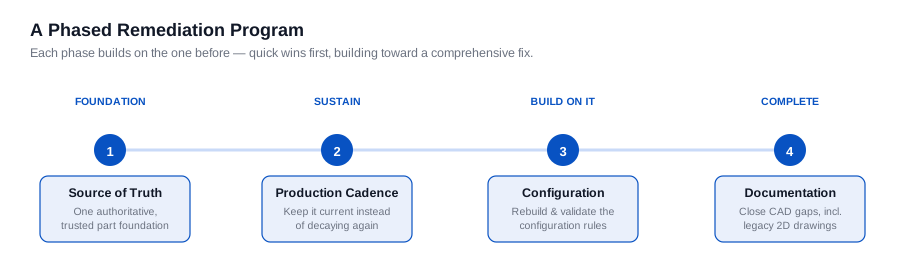
Establish a single source of truth for product data. Before anything else, the organization needs one place where product data is authoritative, complete, and trusted. This is the foundation the rest of the program depends on. It begins with the highest-priority, highest-volume product lines — the ones where clean data pays off fastest — and expands in waves guided by data availability, engineering input, sales volume, and complexity. The techniques behind this phase are covered in how AI reconciles broken product data.
Refine and move it into production. A pilot proves the approach; the next step is turning that into a repeatable production cadence, so the source of truth stays current instead of decaying again.
Build configuration and routing on top. Once the part foundation is solid, the highly configurable product lines can have their configuration models and rules reconstructed — replacing sparse, out-of-date documentation with a validated, maintainable ruleset. That workstream is covered in rebuilding configuration rules trapped in the ERP.
Close the documentation gaps. Finally, the missing engineering drawings — including the backlog of hand-drawn 2D drawings that were never modernized — get remediated, completing the technical documentation. See using AI to convert legacy 2D drawings into 3D CAD models.
What makes this newly possible: AI with engineering in the loop
Programs like this have always been theoretically possible and practically prohibitive — the manual effort to reconcile hundreds of thousands of parts and thousands of drawings was simply too large. Two things change that.
The first is AI-accelerated data extraction and validation. AI can read existing drawings, documentation, and system records and propose the structured data — reconciling part records, extracting configuration rules, drafting the missing attributes — at a speed no manual effort could match.
The second, and the part that actually makes it work, is keeping engineering in the loop. AI proposes; engineering validates. Every automated match, extracted rule, and generated model is reviewed and confirmed by the people who know the products, on a regular cadence, before it becomes authoritative. This is the difference between a demo and a dependable result: the AI does the heavy lifting, and human expertise governs the truth. It is a force multiplier for a stretched engineering team, not a replacement for their judgment.
The takeaway
The companies that carry this kind of data debt often treat it as permanent — the cost of being old and complex. It is not. The debt is structural, which means a structural fix works: establish a trusted foundation, maintain it systematically, and use AI to make the once-impossible remediation effort achievable. The reactive loop can be broken. It just takes changing the system rather than fighting the symptoms.
This is the first in a series on how we approach product-data remediation for complex manufacturers. The companion pieces go deeper on reconciling broken part data, rebuilding configuration rules, and converting legacy 2D drawings into 3D models.